Politicon.co
Russification of DPRK?
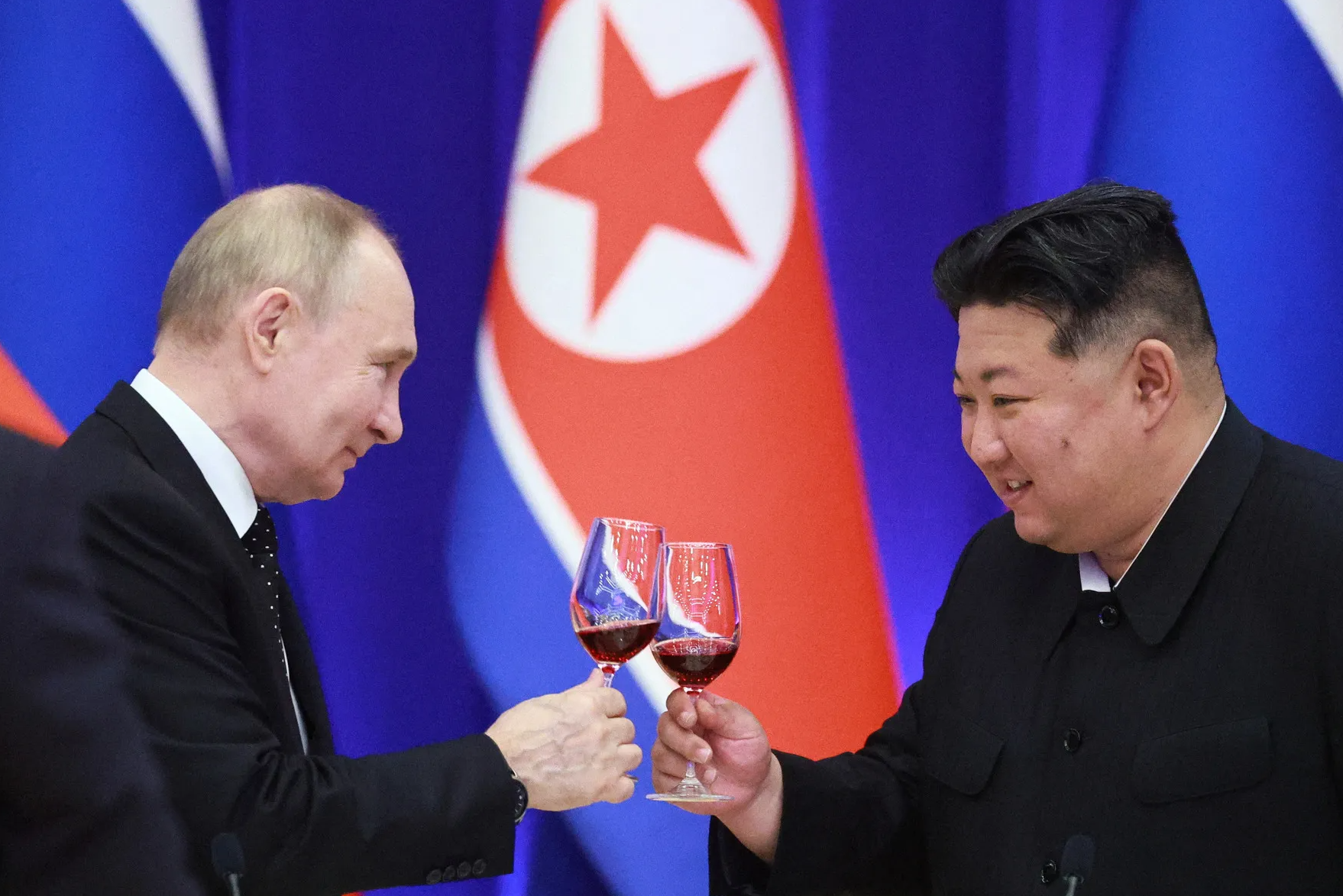
The “reformist” leader of the Democratic People’s Republic of Korea (DPRK), Kim Chŏngŭn, has not hidden his interest in building an image similar to that of Russian President Vladimir Putin rather than that of President Xi Jinping in the People's Republic of China or that of his predecessors Kim Ilsŏng (1912–1994) and Kim Chŏngil (1941/1942–2011).
Since both share a more or less similar ‘European background’ - President Vladimir Putin served as a KGB liaison officer with the Stasi (Staatssicherheit) from 1985-1990 in Dresden, German Democratic Republic, and Kim Chŏngŭn lived for around 9 years in the Helvetic Republic of Switzerland (1991-2000), where he studied at the private Bern International School in Gümligen (1993-1998) and at the Liebefeld Steinhölzli state school in Köniz (1998-2000), both in the canton of Bern.
This sign of ‘European experience’ can be observed in the way Kim Chŏngŭn prefers to be portrayed today before the public by the DPRK's propaganda machine, no longer in a Stalinian aureola, but in a more human image, for example by visiting department-shops with his daughter Kim Ch'uae, riding a horse with his wife on Mount Paektu, visiting educational institutions, inaugurating newly completed works or making visits to various branches of the Korean People's Army and meeting friendly with the soldiers. Meanwhile, since February 2021, KCNA (Korean Central News Agency/ 조선중앙통신), the state media of the DPRK, in its foreign-language articles, began to refer to him as ‘President of State Affairs’ instead of ‘Marshal of the Republic’ or ‘General Secretary’ during international state visits or meetings with world leaders.
As we aforementioned, this ‘normalization process’ undertaken by the DPRK government is largely modelled on President Putin's public image in Russia, which appears to be very balanced, moderate and closer to the ‘European models’ with which Kim Chŏngŭn grew up – but, at the same time, this adaptation of the Russian leadership model re-enacts a very particular and pivotal moment in the history of the Korean state.
On October 12, 1897, as Russia's influence in Korea was growing, after the Agwan p'ach'ŏn incident (‘아관파천’) of February 11, 1896, on the newly constructed altar of the Hwangudan (‘환구단’), for the first time in Korean history, King Kojong of the Chosŏn Dynasty assumed the title of Emperor (‘Hwangje/황제’). The country's former name, ‘Chosŏn/ 朝鮮’ (‘Morning Freshness’), bestowed by the Emperor of China, to whom Korea had been a tributary since the Three Kingdoms period (around 57 BC. – 668 AD), was replaced by ‘Great Han’ (‘Taehan/대한’). The word ‘Empire’ (‘Cheguk/제국’) was added to the state's name, in what can be seen as a parallel to what the Russian Tsar Peter the Great (1672–1725) did after his victory in the Great Northern War (1700–1721) against the Swedish Empire, by proclaiming himself Emperor and declaring Russia an Empire.
Kim Chŏngŭn appears to be repeating the same move by the Chosŏn king today by adapting the Russian title ‘President/ Президент’ (with which the Russian leader identifies) and by constructing a public image similar to that of the Kremlin ruler:
Firstly, through military victories, illustrated with the deployment of the militia units Ch'almal-1 and Ch'almal-7 to support the Ba’athist government of Syrian President Bashar al-Assad during Syrian Civil War (2011-2024) or of the elite units from the 11th Corps of the Korean People’s Army to assist the Russian Army's military operations as part of the Kursk counter-offensive (2024-2026), decisions which politically represent a blend of President Putin's public image in Russia as a strong and victorious leader, constructed and solidified especially during the Second Chechen War (1999–2009), and that of his grandfather, Kim Ilsŏng, who often did not hesitate to send thousands of troops and specialists overseas to assist in communist revolutions or anti-imperialist movements, such as during the Vietnam War (1964–1972), the Yom Kippur War (1973) or the Angolan Civil War (1970s–1980s);
Secondly, there is the country's ambitious modernization program, which many experts and scholars compare it today to the ‘Ch’ŏllima Movement/천리마 운동’ of his grandfather, Kim Ilsŏng, in the late 1950s (which on the other hand was very similar to Stalin’s industrialization of Soviet Union during 1930’), or with modernization process that Russia went through especially during President Putin first presidential terms (2000-20008), and which is symbolized by the grandiose construction of urban, economic and housing infrastructure, as in the case of the futuristic residential skyscrapers on Sŏnghwa Street and in the Hwasŏng District of P'yŏngyang, the new luxury Wonsan Kalma Coastal Tourist Zone, which stretches 4 km along Myŏngsasimni Beach on the shores of the Sea of Japan or the large-scale greenhouse farm projects, as the Sinŭiju Combined Greenhouse Farm;
And thirdly, it is the ongoing process undertaken by Kim Chŏngŭn to transform the DPRK into a factor of strategic importance not only at the regional level but also internationally, which marks a turning point in the history of the DPRK's foreign policy, having officially abandoned the isolationist and balanced diplomatic ‘neutrality’ established by his father, Kim Chŏngil, after the fall of the Eastern Bloc (1988-1991) and the Soviet Union (1991), in order to adopt a more engaged policy on the global stage, as it was also seen during the official visit of DPRK Foreign Minister Ch'oe Sŏnhŭi to Belarus and her participation in the 3rd Minsk International Conference on Eurasian Security, on October 28-23, 2025 and by DPRKby lately enthusiastic participation in the Russian-led initiative of ‘Eurasian Charter of Diversity and Multipolarity in the 21st Century/Евразийская хартия многообразия и многополярности в XXI веке’.
All of the aforementioned aspects of Kim Chŏngŭn's political and public image represent a radical shift from the almost divine image of a traditional dynastic leader of his predecessors to that of a modern, visionary statesman respected internationally and actively engaged in regional and global geopolitics affaires-an image which appear not-surprisingly to be in many aspects similar to that of President Putin in Russia and in post-Soviet space.
Consequently, this adoption of Russian model of public and political image by of Kim Chŏngŭn, not only does it mark a schism from the classic leadership style of DPRK's ruling dynasty, but it also paves a new path that appears to be prepared for his successor from the ‘Paektu Mountain bloodline’ (‘백두혈통’): his daughter, Kim Ch'uae.
- REGIONS :
- East Asia and Pacific
- Russia and CIS
About The Author
Eljanos Kasaj
Eljanos Kasaj
Expert
Eljanos Kasaj is a student from Albania, specialized at the Institute of Politology and World Politics, on the specialization of Global Security, in University of Wroclaw (Poland) and currently continuing studies at International Relations Department at Adam Mickiewicz University in Poznan (also in Poland).
png-1773130770.png)
jpg-1599133320.jpg)