Politicon.co
The phenomenon of escapism in Post-2022 Russian society
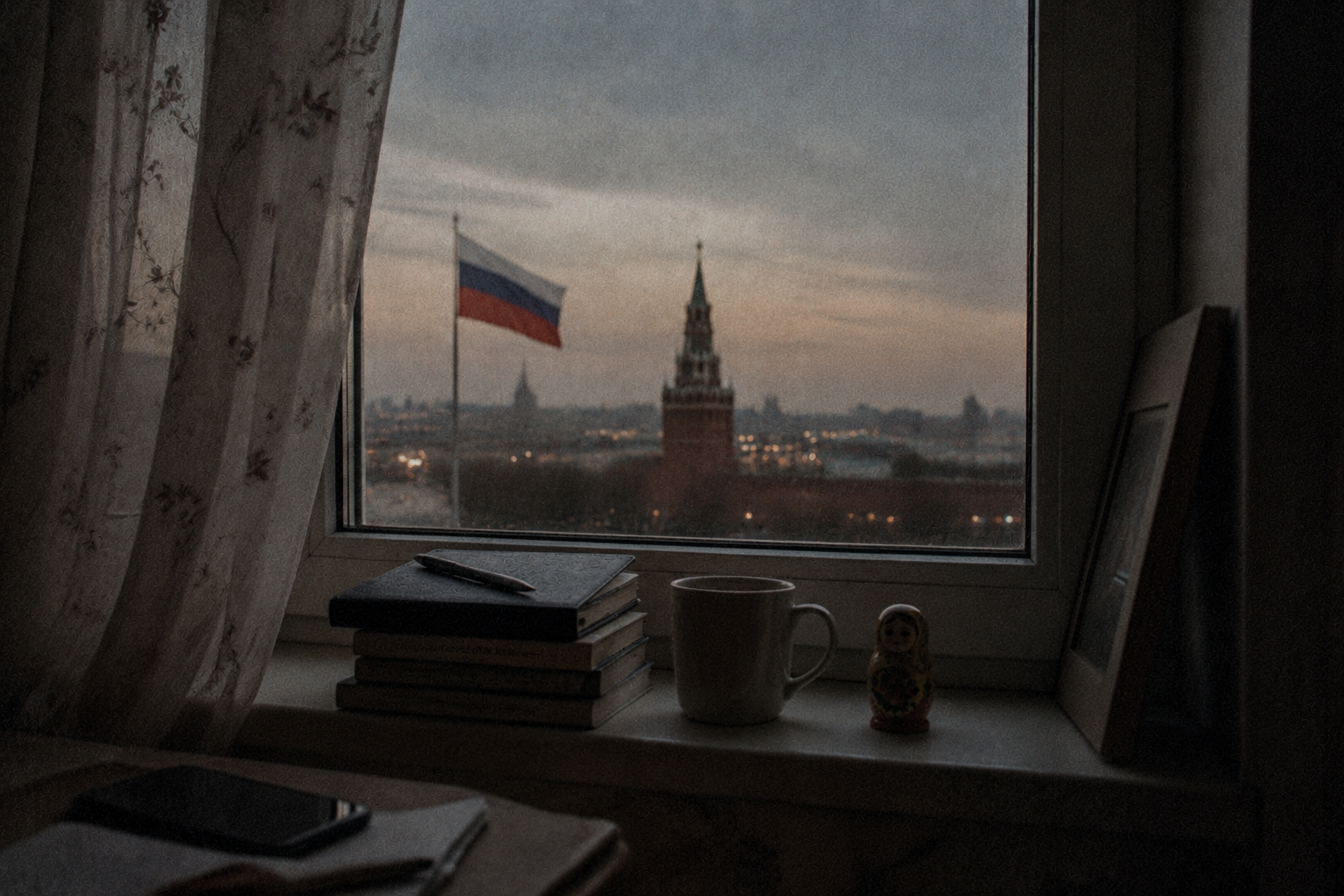
Since the start of the Russo-Ukrainian war on 24 February 2022 and the imposition of harsh punitive sanctions by the West (the European Union, Great Britain, the United States, etc.), thousands of journalistic reports, macro-documentaries, travel vlogs, and street interviews have appeared on major global social media platforms (such as YouTube, Instagram, TikTok, Rednote, etc.). These pieces have aimed to show how the lives of ordinary Russians continue within Russia despite the country’s diplomatic, economic, and socio-cultural isolation.
Many of these independent Russian (or foreign) journalists, bloggers, influencers, and social media personalities—driven either by political-cultural leanings mostly sympathetic toward Russia or simply by ordinary human curiosity—have revealed to a global audience, whether intentionally or not, a striking reality. Despite the fact that their country is in the midst of an ongoing brutal war and under more economic sanctions than the Islamic Republic of Iran, the Democratic People's Republic of Korea, and the Syrian Arab Republic (during Baʿth Party rule) combined, the Russian people continue to live their daily lives as if nothing has happened.
This picture becomes highly contradictory when the outside audience watches reports from major global media outlets (such as the BBC, CNN, AFP, Al Jazeera, etc.)—which show how the Russian army today finds itself in a situation mirroring that of the Soviet military during the Afghan War (1979–1990), how Russia is reaping "Pyrrhic victories" that cost them dearly in human lives, and how each day of fighting on a front line stretching hundreds of kilometers across eastern Ukraine costs the Russian state budget millions of rubles.
Despite all this news, which in many Western countries would have caused widespread discontent, concern, and protests from civil society, activist groups, and NGOs, the exact opposite seems to be happening in Russia.
Russian tourists continue to quietly holiday at Black Sea resorts in Crimea, Sochi, or Anapa—despite the fact that Ukrainian drones carry out attacks almost every week on military targets, logistical networks, or industrial facilities in these locations. Gala festivals and popular artists' concerts in Russia's two capitals, Moscow and Saint Petersburg, continue to see broad participation from hundreds of thousands of young Russians. This persists despite the fact that both metropolises have also been targets of Ukrainian drone strikes and Ukrainian intelligence service operations aimed at eliminating senior Russian military figures.
Tickets for theater performances, classical music concerts, or the latest premieres from the world's biggest film industries (American, European, Chinese) sell out in an instant. The Russian public appears more eager for art and culture than ever before, despite the fact that a large number of world-renowned Russian artists, filmmakers, and writers have been forced into exile or self-exile for opposing the Kremlin's policies or state censorship. Meanwhile, on Russian state and private television channels, the war in Ukraine is presented in a standardized format designed to make it feel geographically distant to audiences. It is framed similarly to media coverage of the Russian military interventions in the Syrian Arab Republic or the Sahel countries in Africa, even though it is taking place in a country that directly borders Russia territorially and not on another continent.
When these extreme dual realities are revealed to the outside world, they are initially met with astonishment—especially regarding how the Russian state continues to function normally despite international political isolation and harsh Western economic sanctions. This astonishment is invariably followed by questions: How is it possible that the Russian people continue to live so normally when, every day, thousands of Russian soldiers are losing their lives, being wounded, or being taken as prisoners of war? How is it possible that Russian society does not react when drone attacks or assassination attempts on senior state figures occur almost daily in major cities? How is it possible that the Russian public quietly aligns itself with the propaganda spread by pro-government media and regards a war taking place on its country’s border as something distant and inconsequential in their daily lives?
The answer to all these questions can be summed up in a single concept that explains all the socio-psychological processes taking place in Russian society: Escapism.
Escapism as a socio-psychological phenomenon in Russian society
Escapism is a term used in psychology (as well as in sociology and existential philosophy) to describe the complex psychological mechanism by which an individual or a society confronts harsh, unpleasant, or deeply disturbing realities by immersing themselves in a closed routine. This routine focuses largely on things that offer pleasure and tranquility, such as pursuing an artistic life, traveling abroad, or spending time with friends and family.
In the context of modern Russian society, this phenomenon has developed rapidly and according to all its natural dispositions. Finding itself under constant pressure from the country's socio-political and economic realities, the public has driven itself toward this desperate psychological solution.
However, what makes the Russian case unique is that society did not choose escapism entirely organically, as many societies have done throughout history. The Russian government itself has also played a decisive role by actively encouraging and stimulating this societal mechanism. Thus, modern Russian escapism manifests in two distinct forms: State-led Escapism and Societal Escapism.
State-led escapism
Societal Bifurcation, also known as Bifocal Vision, is a socio-political condition in which a government aggressively pushes an extremist wartime narrative on the population while simultaneously protecting the economy and major administrative hubs (such as the capital) from the immediate impacts of war, thereby preventing any possible mass civil unrest. In this context, the population is compelled to act with a "bifocal" perspective, seeing one reality up close (their personal, untouched daily lives) and a completely different reality at a distance (the ongoing war reported by media outlets as something distinct or located very far away from them).
This is the actual socio-political situation of Russia today—where the Russian government has aggressively constructed this bifocal reality for its citizens, based on two methods of psycho-emotional control of the public:
The first method involves isolating society from sensitive information or material that could trigger a strong socio-psychological impact and spark massive outrage. This was evident in the way Russian authorities suppressed all news coverage of the Alexander Okunev case. Okunev, a 37-year-old Kaliningrad resident, set himself on fire at the foot of the 1,200 Guardsmen memorial on 24 February 2025 as an act of protest against Russia's war in Ukraine on the third anniversary of what Russian authorities call the ‘special military operation’. His story may have remained forever unknown to the public had it not been uncovered by a joint investigation by the Russian investigative media outlet iStories, the Estonian news portal Delfi, and the Lithuanian public broadcaster LRT.
The second method involves extensive efforts to project an image of absolute normality to the public. This was clearly evident during two of Russia's most important international events this year: the 29th St. Petersburg International Economic Forum and the ASEAN-Russia Commemorative Summit in Kazan. During both events, Russia's largest metropolises, St. Petersburg and Moscow, experienced some of the largest Ukrainian drone attacks since the start of military operations in 2022. Yet, despite significant damage and panic among citizens, Russian authorities proceeded with their scheduled programming—holding head-of-state meetings, round-table discussions, and joint press statements as if nothing had happened.
Societal Escapism
Compartmentalization is a classic psychological defense mechanism used by civilian populations (or individuals) during extreme societal crises, such as full-scale wars or under the harsh repression of oppressive authoritarian regimes. Through this socio-psychological mechanism, society normalizes the abnormal by building a wall of cognitive dissonance: people attend concerts, frequent cinemas and theaters, go on holiday, and start families—consciously or unconsciously keeping the macro-political reality on the periphery of their daily lives.
In today's Russian society, we find this socio-psychological phenomenon expressed in four distinct ways:
Escapism through Art
With international travel to classic cultural destinations (such as Florence, Paris, Dresden, etc.) severely restricted, and partnerships with international institutions limited mainly to those in the People's Republic of China or Southeast Asian countries, visits to local Russian museums and galleries—such as the Tretyakov Art Gallery or the Pushkin Museum of Fine Arts—have risen to record levels. This massive attendance at these cultural institutions also indicates the Russian public is more eager than ever for masterpieces of Western classical art. Audiences flock to exhibitions featuring Italian Renaissance biblical paintings of the 14th–16th centuries, Dutch Golden Age landscape art of the 16th–17th centuries, or the tableaus of 19th-century French Impressionism.
This flood of visitors occurs primarily because these cultural institutions maintain exhibition schedules that are strictly apolitical and dedicated entirely to world and Russian classical art. Consequently, they have become some of the few places where Russian people can escape, if only for a few hours, the Kremlin’s aggressive pro-war state propaganda found everywhere else, from daily television broadcasts to massive street hoardings.
Escapism through Cinema
Following the withdrawal of international streaming services like Netflix, Amazon Prime Video, and Disney+ from the Russian market, and the decision by major Hollywood studios to halt theatrical releases in Russia, Russian cinemas have been entirely dominated by domestic productions. These generally fall into three categories: epic propaganda films (including "patriotic" films about the war in Ukraine or World War II), fairy-tale films (mostly re-adaptations of Soviet children's classics), and ethnic films (produced within Russia's national or indigenous republics).
Of these three categories of film productions, the most popular—at least among residents of major urban centers such as Moscow, Saint Petersburg, or Novosibirsk—has been and continues to be fairy-tale films, which have even set historic records in ticket sales.
The reason for this massive appetite for fairy tales—a unique form of escapism in itself—lies in the fact that these films are completely detached from political realities and pressing social problems, elements that have long been hallmarks of modern Russian cinema (as seen in films like Leviathan or Seagulls). As Russian film critic Anton Dolin ruthlessly describes it, the modern Russian audience prefers to be "fed on chocolate" to escape its daily reality.
Escapism through Theater and Ballet
Anton Chekhov's plays, Alexander Borodin's operas, and Pyotr Tchaikovsky's ballets are just some of the classic masterpieces of the Russian and global stage. Once celebrated as symbols of the Westernization of Russian culture and its imperial intelligentsia, they have today been turned into "therapeutic" sessions for the psycho-emotional and spiritual state of millions of Russian citizens, who are worn down by relentless warmongering propaganda.
Because catharsis—the spiritual purification through art that the ancient Greek thinker Aristotle explored in his work Poetics—has become increasingly difficult to find in contemporary Russian art, classic theater, opera, and ballet have become the only remaining avenues for the public to achieve it.
Ethno-Escapism
While one segment of Russian society (primarily ethnic Slavic Russians) has sought salvation from harsh realities by immersing themselves in classical art, ballet, and fairy-tale films, another segment has reacted differently. The ethnic and indigenous peoples of Russia (such as the Sakha, Tatars, Buryats, Kalmyks, etc.) have catalyzed their socio-political quietism into a unique form of resistance against Moscow’s oppressive policies by using their national culture as a shield. This has led not only to a revitalization of their national cultures but also to an unprecedented boom in the ethnic cinematic industry.
Cinema has long been weaponized as a powerful tool of soft power, as is seen nowadays globally with South Korean K-dramas, Thai GL dramas, or Japanese anime. Similarly, the ethnic republics of Russia have learned to utilize film to promote their ancient cultures to both national and broader global audiences while also passing down their languages, customs, and traditions to younger generations.
At the same time, the boom in these regional cinematic industries can be viewed as an effort by local cultural circles (and indirectly by governmental ones) to insulate their communities from Moscow's aggressive wartime narratives. Driven by the deep interest of indigenous peoples (especially youth) in their own historical and cultural heritage, this movement represents a unique blend of state-supported and societal escapism anchored firmly in elements of ethnic identity.
The effects of the phenomenon of escapism in Russian society
When a society enters a prolonged state of collective escapism, the consequences extend far beyond mere distraction. On a political level, this allows repressive government policies to continue entirely unchecked. On a psychological level, it causes severe trauma both to collective society and to the individuals within it.
The most catastrophic of these consequences for a society may include:
Emotional Desensitization and Societal Apathy
Excessive exposure to curated, fictional or state-verified virtual realities causes psychological numbness. When this condition spreads widely, society becomes deeply apathetic towards real-world suffering. In contemporary Russia, this manifests as a detached and cold attitude among millions of citizens—particularly in major urban centers such as Moscow, St Petersburg or Nizhny Novgorod—towards the ongoing destruction in Ukraine and the economic or physical suffering of people within their own country's borders.
Compassion Fatigue and Political Passivity
Continuous engagement with idealized parallel narratives makes the current messy (sometimes chaotic), brutal realities of human life seem insurmountable and unpleasant. As a result, many residents of major Russian cities have simply stopped processing the ongoing war in Ukraine. Thus to preserve their psycho-emotional peace, they retreat into hyper-individualism, focusing strictly on personal well-being and daily routine (work, family, hobbies) while actively ignoring the (geo) political actions undertaken in their name.
The Modern "Witch-Hunt"
As the Kremlin's wartime narrative is continuously broadcast by pro-government media, the collective desire to preserve an escape bubble creates an aggressive defense mechanism: the fixation on ‘internal enemies.’ Recalling Stalin's Great Terror of the 1930s, contemporary Russian society is seeing deep rifts of suspicion among it. Paranoia and accusations of ‘treason’ regularly surface between those who strictly follow the Kremlin line (mainly old generation) and the opposing minority (especially young generation) that tries to force reality back into public consciousness.
"Othering" and the Rise of Xenophobia
The isolation of a population within virtual echo chambers and state-sanctioned myths encourages people to view outsiders as abstract concepts rather than as human beings. This systematic dehumanization serves as a psychological justification for extreme violence that has lately occurred in Russian society (especially towards woman). Furthermore, it fuels deeply rooted xenophobia. This has catalyzed the rise of radical nationalist sentiments across Russia, often targeting Central Asian and Caucasian migrants, as well as the country's ethnic and indigenous minorities (such as Sakha, Tuvans, Buryats, etc.).
Conclusions
The four years of the war in Ukraine—a period now spanning longer than the Great Patriotic War (1941-1945)—have triggered profound socio-psychological transformations within Russian society.
While it initially served as a protective shield against aggressive state propaganda, its prolonged prevalence has fundamentally altered the public psyche. Behaviors that began as defense mechanisms—such as political passivity, deliberate self-isolation from disturbing news, and a hyper-focus on personal well-being—have hardened into a permanent way of life.
However, this forced psychological insulation carries a dark side. The friction between internal avoidance and relentless state pressure has begun to fracture Russian society, manifesting as sudden bursts of aggressive nationalism and rising hostility within families and educational institutions (lately especially in schools). Alongside rising violence, aggressive nationalism has emerged as a dominant psychological coping mechanism of escapism from the harsh reality, aiming to find someone to blame for its problems.
Ultimately, this deep-seated psychological strain has left Russian society highly vulnerable to radical, violent political movements—a fragility that could easily lead Russia into future chaos.
- REGIONS :
- Russia and CIS
About The Author
Eljanos Kasaj
Eljanos Kasaj
Expert
Eljanos Kasaj is a student from Albania, specialized at the Institute of Politology and World Politics, on the specialization of Global Security, in University of Wroclaw (Poland) and currently continuing studies at International Relations Department at Adam Mickiewicz University in Poznan (also in Poland).
jpg-1781074374.jpg)
jpg-1599133320.jpg)