
Politicon.co
Armenia and Kazakhstan: what are the reasons for strong bilateral relations and effective cooperation?
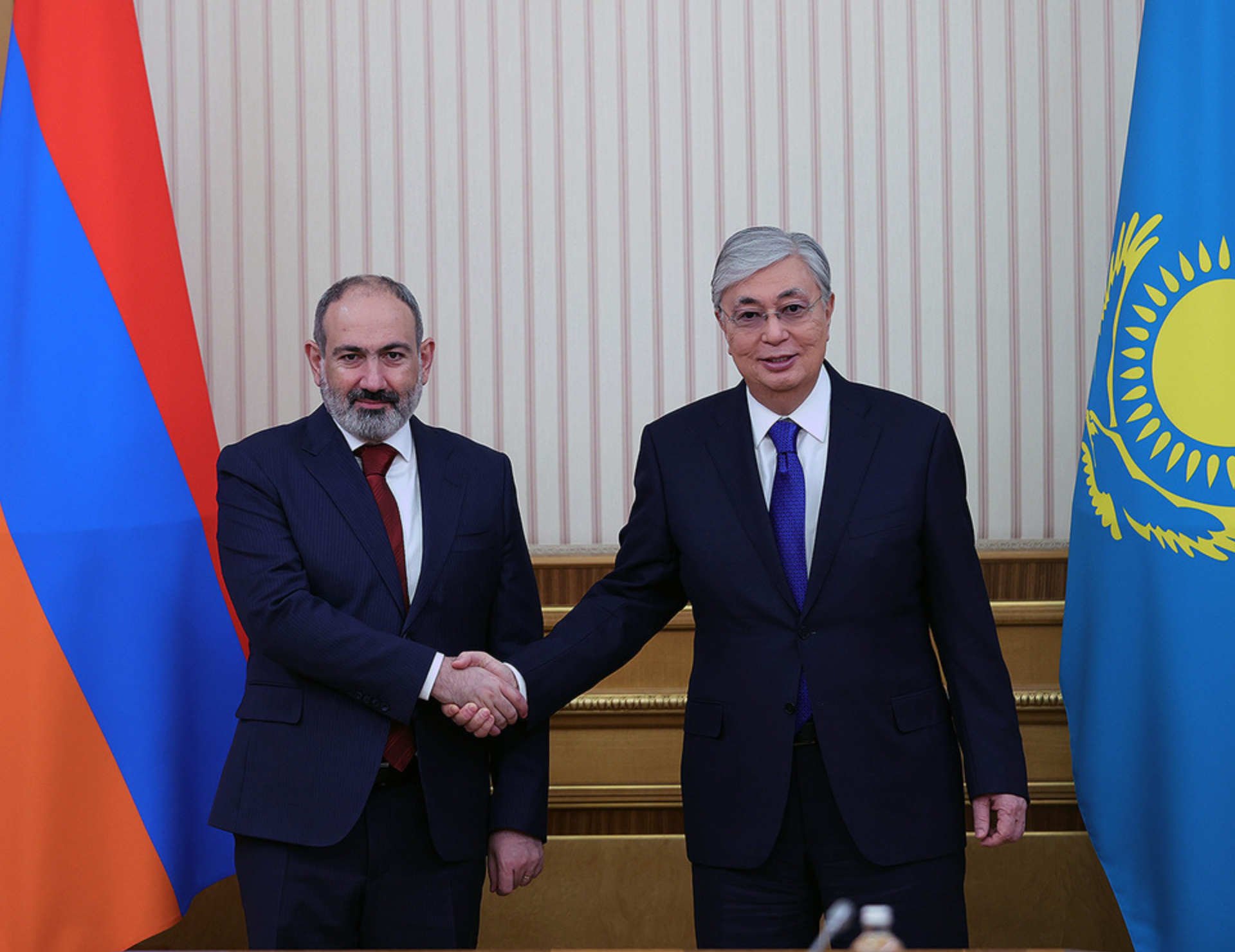
Relations between Armenia and Kazakhstan have long represented one of the more complex issues within Kazakhstani foreign policy, particularly before the restoration of Azerbaijan’s territorial integrity and sovereignty following the Second Karabakh War. Both post-Soviet countries traditionally maintained good relations, with embassies in both countries, and, in general, mutual perceptions of their societies were neutral toward each other due to the absence of major conflicts between the Central Asian Turkic peoples and the Armenians. Historically, certain incidents could potentially negatively affect communication between these groups, such as the participation of “Dashnaktsutyun,” the nationalist Armenian political party that also operated armed units in the early 20th century, in military actions against the Turkestan Autonomy and the Basmachi movement during the establishment of Soviet rule in Central Asia. Soviet authorities engaged Armenian units in fighting local anti-Bolshevik forces, partly motivated by the presence in the Turkestan region of Enver Pasha, one of the three Ottoman Pashas who ruled the Ottoman Empire between 1913 and 1919 and who is identified by Armenians as a contributor to the “genocide” of the Armenian population in 1915.
At the same time, the artificial famine initiated by Stalin’s regime in the name of collectivisation and conducted by Goloshchekin stopped with the arrival of the new First Secretary of the Kazakh SSR, Levon Mirzoyan, an ethnic Armenian, who is known for his anti-Azerbaijani campaigns when he was serving as Deputy Secretary of the Azerbaijani SSR. Such campaigns included restrictions on the commemoration of Ashura of the Prophet Ali during the month of Muharram and discrimination against the Azerbaijani language in courts, which adds more controversy to the historical dialogue of Armenian and Kazakhstani relations: on one hand, Mirzoyan was suppressing the Turkic population in Azerbaijan, but on the other hand, he helped ethnic Kazakhs recover from genocide. These two key events have impacted the formation of communication between the states after the restoration of independence following the collapse of the Soviet Union.
In the context of the Armenian-Kazakhstani relations in their post-Soviet era, it is necessary to comprehend the most important factor: Kazakhstan always positions itself as a country that views territorial integrity and sovereignty of the country in the borders recognized by international law as the priority and never accepts any instances of separatism or the creation of any kind of “buffer zones." This position never changed and remained similar since 1991, which is why Kosovo, South Ossetia, Abkhazia, Donetsk, and Luhansk have never been considered for recognition in Kazakhstan, which has been confirmed by Tokayev during the Saint-Petersburg Economic Forum in 2022. Karabakh, until its liberation, had never been considered an independent subject or legitimate territory of Armenia; in contrast, it had always been accepted exclusively as a territory of Azerbaijan. Though it did not affect the relations between the two countries for a long time, a large role was played by Nazarbayev and his interests. The first president of Kazakhstan has always viewed all pro-Western regimes and the West itself more as a threat since they were frequently criticising autocratic rule in Kazakhstan. Moreover, his stereotypical vision of the United States, derived from his prism of Soviet nomenclature, was affecting his perception of the US. In this regard, it was easier for Nursultan Nazarbayev to communicate with previous leaders of Armenia, Ter-Petrosyan, Kocharyan, and Sargsyan, as they were direct allies of Russia, who were more understandable for him compared to the Aliyevs, more oriented to Euro-Atlantic development, refused to join the CSTO and Eurasian Economic Union, and were not that active in the CIS. Armenia, in contrast, had been demonstrating high loyalty to Russia before the arrival of Nikol Pashinyan, and it was building better mutual understanding between Astana and Yerevan, with Russia as a large player in multipolar organisations.
However, despite mutual interests and participation in different organisations, Astana was still balancing between the two South Caucasian countries, which were in conflict: in 2016, Kazakhstan refused its participation in the forum “Invest Armenia” and, following that event, declined its attendance to Yerevan for the Eurasian Economic Union meeting on a high level, offering instead to conduct it in Moscow. Armenian leader of these years, Serj Sargsyan, openly accused Astana of sabotaging these events due to “clearly geopolitical reasons," directly referring to the four-day war between Azerbaijan and Armenia in April. Both of the events took place exactly in April, so Nazarbayev’s government has given quite clear signals that Kazakhstan was not supporting Armenia in the escalation of the conflict, instead showing its solidarity with the Azerbaijani side. Since relations between Baku and Yerevan have been far from good, particularly that year, Nazarbayev skipped meetings with Aliyev and Sargsyan on the 12th and 14th of October in 2016, indicating that the official reason was a “common cold."
Analyzing all of these events and considering the context, it is obvious that, despite fundamental commitment to international law in terms of respect towards sovereignty and integrity, Kazakhstan has been forced to build up intensive dialogue with Armenia due to the vision of politics and preferences from the perspective of Kazakhstan in Nazarbayev’s era, together with engagement with Yerevan in the same platforms in a plethora of international organizations and multilateral platforms as well as a formal alliance in CSTO with Russian dominance. Armenia was perceived as a more predictable partner for Astana, as Sargsyan was closely aligned with Russia, similar to Ivanishvili in Georgia. A comparable dynamic could also be observed in Kazakhstan’s relations with Tbilisi: Astana was relatively less active in its engagement with Saakashvili, while maintaining significantly friendlier relations with Gamsakhurdia and Shevardnadze. At the same time, the economic interests of Kazakhstan, which felt way more comfortable in those days trading with Russia, were easily satisfied in the Moscow-Yerevan chain; the public in Kazakhstan was enjoying business relations, trade, and especially the import of vehicles from Armenia due to their comparatively low prices, which was possible due to Eurasian Economic Union regulations.
Dynamics of relations between the two countries definitely shifted after Tokayev became president of Kazakhstan. During Nazarbayev's tenure, economic relations were coming alongside with wider political solidarity between Moscow, Yerevan, and Astana. Nazarbayev’s main incentive in maintaining the status quo was due to his unwillingness to “choose sides." However, the transition of relations was unpredictable for Armenia after Nazarbayev’s withdrawal from the presidency because Tokayev, in comparison to Nazarbayev, was not showing significant political solidarity with Armenia. Tokayev switched the good relationship status with Yerevan to neutral, and, while he maintained commitment to all economic initiatives and trade and business-oriented beginnings, he nevertheless changed the rhetoric and foreign policy in general. Tokayev, as an experienced diplomat and a figure who took crucial positions in the UN, is more committed to respect towards international law, which explains why his stance on the dispute over Karabakh was more in favor of Baku, since there are facts of recognition of Karabakh as a territory of Azerbaijan by all UN resolutions. In general, the vector of foreign policy, alongside the attitude changed towards Moscow, too, so Astana, during Tokayev, started to become less dependent on its traditional partners, developing relationships with Türkiye, Central Asian countries, and Azerbaijan, with better relations towards Western countries.
The ideological switch of Kazakhstan started to be way more obvious after its decline to support Armenia as an ally in CSTO during the Second Karabakh War, and in 2022, despite the “help” of CSTO member states to Tokayev in the January protests, Astana made it clear that relations with Baku are valuable and prioritized. After this, Kazakhstan started to position itself more as a platform for negotiations between the two states, mediating this conflict, but at the same time developing relations with Azerbaijan way more than before, changing the rhetoric from “important partner” to “brother country," which Astana usually avoided with any state except for Uzbekistan and Kyrgyzstan. Tokayev well predicted that the impact of Türkiye started to increase in the South Caucasus, especially after the Second Karabakh War, so the Turkic narrative stopped being disregarded, and Tokayev represents his commitment to work in this direction. A significant moment in the revival of this narrative is represented by Aliyev’s reelection speech in 2024, when he stated that “we have no other family, our family is the Turkic World”.
In general, good relations with Armenia were and are still based on economic reasons and will keep to be on high level due to the mutual material interests, with changed but still positive rhetoric, especially after Armenian cooperativeness after the Second Karabakh War and the commitment of Pashinyan to develop relations in that direction. However, political solidarity, which used to exist until 2019, before Tokayev’s presidential mandate, has declined. It might be perceived that Yerevan and Astana are “big friends," but mainly it is the heritage of Nazarbayev’s era, where contacts and networking were established in a friendlier context, and today, especially in current geopolitical turbulence, Astana is more interested in the development of relations with Azerbaijan.
- TAGS :
- Armenia
- Kazakhistan
- geopolitics
- TOPICS :
- Foreign policy
- REGIONS :
- Central Asia
- South Caucasus
About The Author

Alibi Beisenov
Alibi Beisenov is a research intern at Topchubashov Center from Kazakhstan. He is a fourth-year student of International Studies at ADA University, with an experience of education in Political Science at Saint Petersburg State University for two years. Currently is president of the Association of Kazakhstani Students in the Republic of Azerbaijan.
His research interests include regional studies, diplomacy, institutional development, and international relations in Central Asia, with a focus on the perspective of CA countries regarding Azerbaijan’s participation in the C5+1 platform.


jpg-1781074374.jpg)

jpg-1599133320.jpg)