
Politicon.co
Asymmetric effect of tariffs on commodities
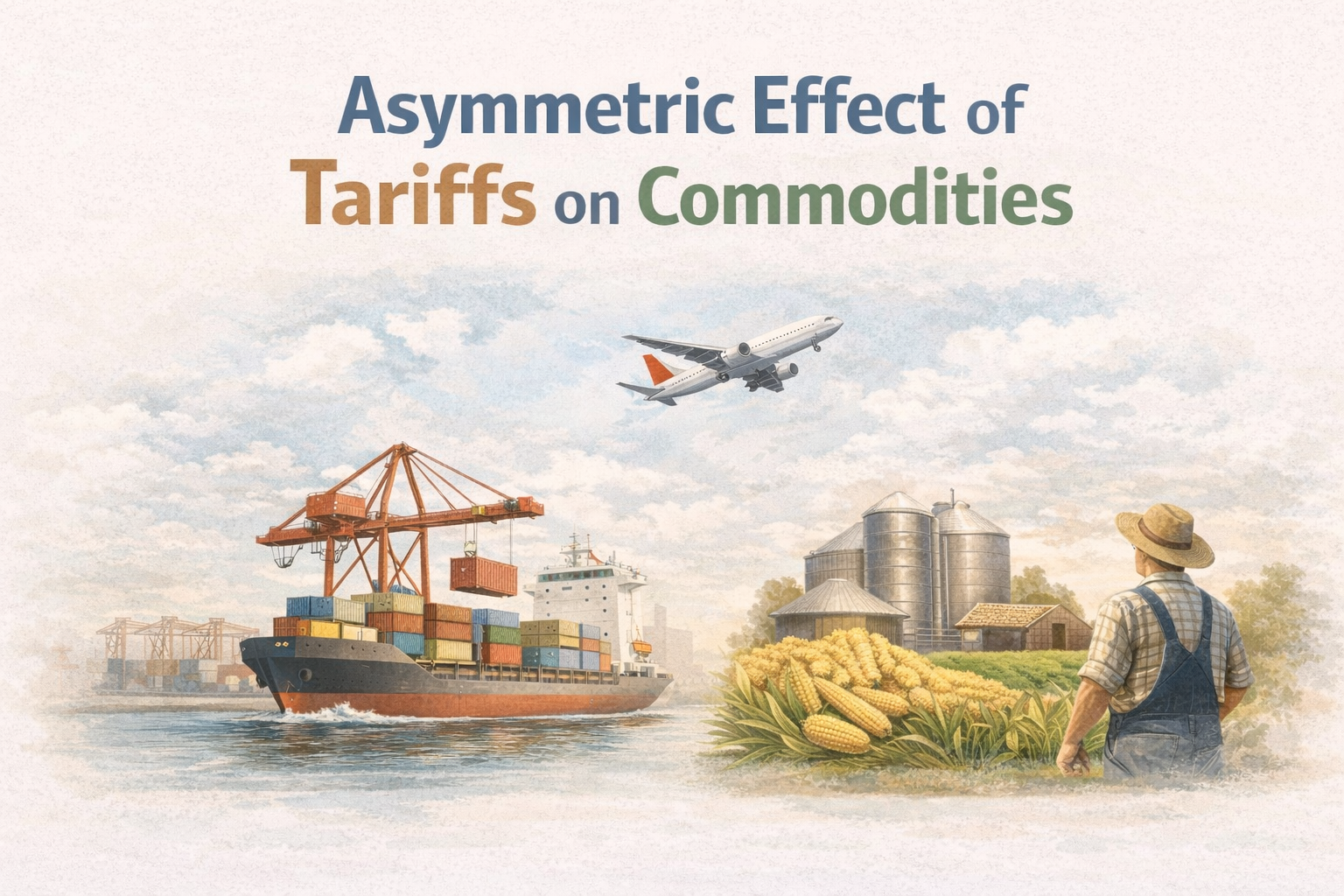
Since tariffs have been back at the centre of economic news, their effects on energy markets have been widely discussed, whereas their asymmetric effects on the tradable sector are largely overlooked by most analyses. Understanding the key drivers behind this asymmetry is paramount because it explains how unemployment, prices, and productivity will change across different commodity markets.
Despite the diffusion of transformation from non-renewable energy sources to green energy, the demand for energy commodities such as oil and natural gas remains high, as forecasted by IEA. This, in turn, explains why, despite being a negative productivity shock, tariffs are not influential enough to eradicate the higher demand for inelasticity for the aforementioned commodities. Thanks to industrial production, transportation, and geopolitical factors, energy markets are comparatively less responsive to the negative energy shocks of tariffs.
However, the scenario is completely different for the metals, as the exporters of those commodities are directly exposed to the negative productivity shocks stemming from tariffs. Policy uncertainties triggered by the higher tariff rates make investment in the metal sector costlier than it ever was before, which ultimately results in capacity utilisation along with an increase in unemployment in this sector. In order to bring the economy back to where it used to be prior to tariffs, there is a need for a significant depreciation or demand of support as an alternative policy in the case of metal exporters. As predicted by the economic theory, the size of depreciation will be significantly less for energy exporters.
What will be the impact on commodity prices?
For the energy exporters, the effect of tariffs on prices is largely muted due to the fact that geopolitical factors so as the global demand for energy, still remain as the key driver of the price in those markets.
Coming to the metal exporters, the situation is much more complex because here the prices are shaped not only by the negative effect of tariffs but also by the large expansion of AI. More precisely, there is an indispensable demand for metals in order to run the AI infrastructure, such as data centers and semiconductors, which has already escalated the price of those commodities. Combined with the negative effect of tariffs, the expansion of AI will further increase the price of metals such as copper and other critical metals. A report by Reuters also depicted that the global copper demand is projected to increase 50% by 2040, while supply will decline by over 10 million metric tons per year. From the standpoint of the basic supply-demand framework, tariffs tend to deteriorate the productive capacity in commodity markets of metals and lead to supply constraints. On the other hand, an expansion of AI increases the demand for those commodities, thus further pushing the prices. The end result will be a price level being much higher than the pre-tariff scenario. Coming to the quantity produced, it depends on the scale of the change, i.e., which side (supply or demand) outperforms the other.
What does it have to do with trade policies?
The “So, what” part of this analysis is that tariffs can be perceived as a sectorally asymmetric instrument since their effect varies across commodity classes. In energy markets, tariffs have a limited effect on the price or production: all it does is alter the route. The metal exporters encounter a scenario in which tariffs drastically impact the investor's incentives by increasing uncertainty and disrupting the supply side. One of the main takeaways is that while the energy market can absorb the tariff-related negative productivity shocks, metal markets suffer in doing so due to the long-term productive capacity damage. Another key lesson here is that while designing trade policies, one has to bear in mind that a more aggressive tariff regime may backfire at the end of the day when the AI comes to the table. Rather than sticking to tariffs, the other alternative, less harmful and more influential methods, such as trade facilitation for critical inputs, should be implemented. Considering the vital role of metals for green and digital transformation, trade policy design should focus more on how to ensure securing future productive capacity rather than being merely about protection.
- TAGS :
About The Author

Nargiz Mammadova
Nargiz Mammadova is an economist specializing in macroeconomics, econometrics, emerging economies, and energy markets, with a particular focus on resource-rich countries. She holds an MPA in International Development (Econometrics & Quantitative Economics) from Harvard Kennedy School, where her research examined economic complexity and financial stability reforms in commodity-dependent economies. Her professional experience spans macro-fiscal forecasting, policy evaluation, and financial market development, including work at the Harvard Growth Lab, the European Bank for Reconstruction and Development, and the State Oil Fund of Azerbaijan.



jpg-1781074374.jpg)


jpg-1599133320.jpg)