Politicon.co
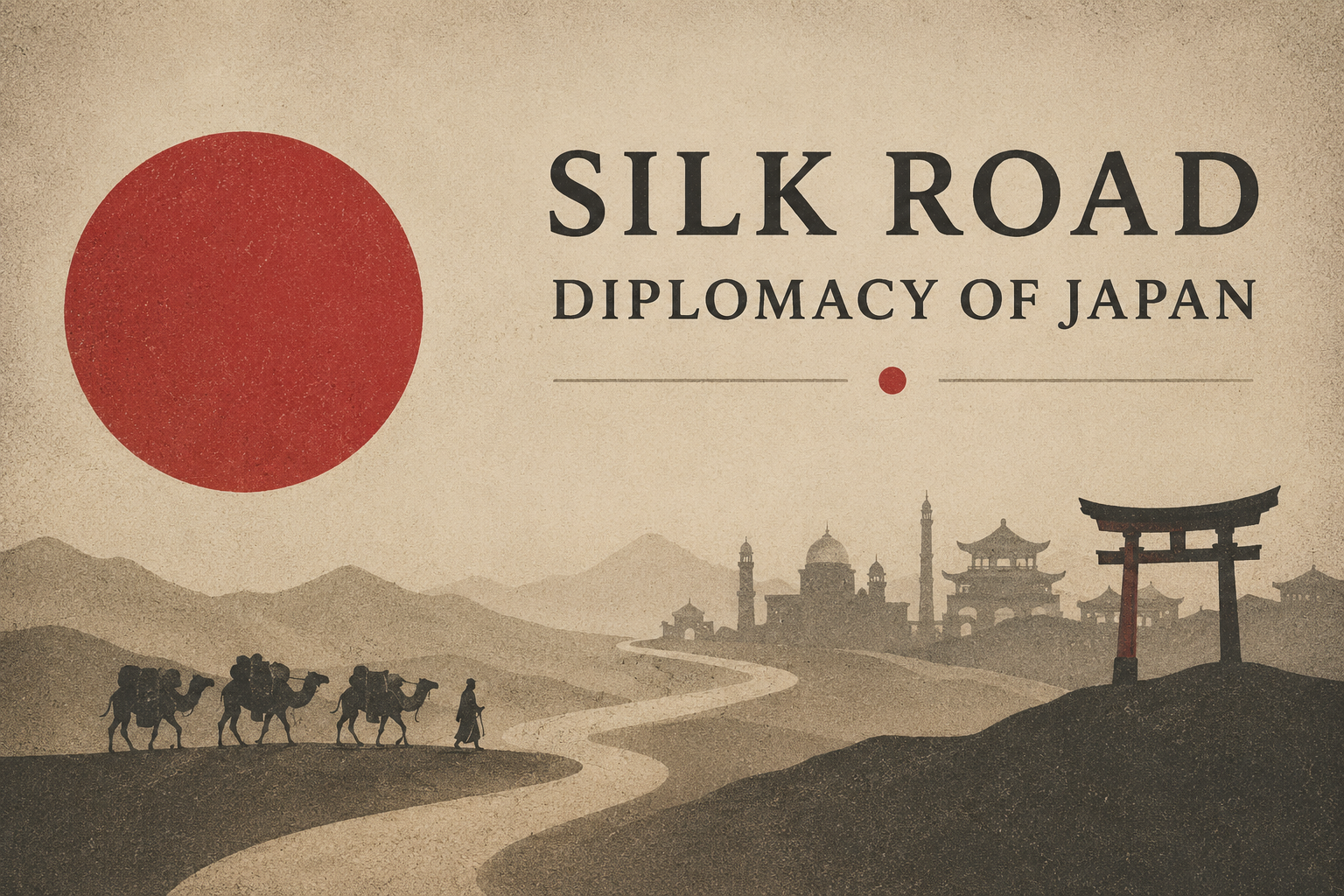
Silk Road Diplomacy of Japan
Central Asia, despite being historically labelled by Western observers and commentators as Russia's ‘backyard’, has lately been regarded also as one of the most ‘stable and peaceful’ regions in current global politics.
Located at the crossroads of ancient trade routes between Europe and Asia – historically known as the Silk Road, the Fur Road or the Tea and Spices Road – the region is one of the main crossroads for transcontinental trade, facilitating the exchange not only of material goods but also of technologies, cultures and religions across Eurasia.
Composed of five countries—Kazakhstan (Қазақстан), Uzbekistan (Oʻzbekiston), Turkmenistan (Türkmenistan), Kyrgyzstan (Кыргызстан) and Tajikistan (Тоҷикистон)— the region is also one of the most ethnically, culturally, linguistically, religiously and historically diverse in the world.
But despite its socio-cultural diversity and extraordinary economic potential—the region's harsh geography, its exotic political orientalism, together with Russia's military presence and the economic presence of the People's Republic of China, has led to it being regarded as highly complex for developing a sustainable and profitable regional-scale cooperation.
This beliefs of Western diplomacy are today being courageously challenged by distant yet aspiring Japan, which has taken the initiative, and is boldly forging an ambitious long-term partnership with the countries of this region.
Precisely this will be the main focus of our analysis – in which we will endeavor to examine how this unique partnership was initially formed, how it historically developed, how it is today adapting to the chaotic geopolitical realities, and how it is reshaping the historical balances of Central Asia.
Japan's historical presence in Central Asia
The Japanese government's interest in Central Asia is not something born of the current chaotic geopolitical and geo-economic realities, but a continuation of a long-standing policy pursued by Tokyo in this region.
Like Seoul and Taipei, Tokyo began to engage officially with the countries of Central Asia in the early 1990s, immediately after these countries gained independence following the collapse of the East Bloc (1988-1991) and the Soviet Union (1991).
However, conscious of the presence of the two great old powers in this region—Russia and the People's Republic of China—Japan never sought supremacy or an equal footing with them. Moreover, the considerable geographical distance between this region and Japan would make any such ambition resemble a daydream.
Thus, for years on end, the Japanese government's focus in Central Asia primarily encompassed official economic development assistance, academic and cultural cooperation, infrastructure investment and institutional cooperation.
Relationships began to become slightly institutionalized at the turn of the 21st century, when in order to strengthen and further expand bilateral relations with the countries of Central Asia, in 2004 Tokyo launched the ‘Central Asia/C5 + Japan’ dialogue – which at the time was the first iteration of the now-popular established ‘C5+1’ format.
However, the dialogue functioned mainly at the level of foreign ministers and remained predominantly technocratic in character. While its focus was largely concentrated on priority areas of cooperation (like environmental stability, urban green transformation and human resources development), it avoided any kind of ideological conditionality, which could have led to possible political contradictions on attempts from Japanese government to weaponize the platform as a tool for intervention in these country’s internal affairs.
This was not coincidental nor a sign that Tokyo viewed the region as peripheral. Through this cunning diplomatic tactic, Tokyo managed to maintain its presence in Central Asia without conflicting with Moscow, which at the time was re-militarizing and re-asserting its century-old security dominance in the region, or with Beijing, which was aggressively expanding economically in this countries, in order to pave the way for its ‘Belt and Road Initiative’ (2013).
The results can be seen today where despite the fact that for about 20 years, since the mid-2000s and early 2020s, Central Asia has been militarily under Moscow's dominance and economically under Beijing's, Tokyo has managed to maintain a stable political and socio-economic foundation in the region—which together with that of Washington, Seoul and Brussels served also as a security valve for the governments of this countries to prevent a total dominance of Russia or People’s Republic of China.
What is Japan is aiming for in Central Asia?
The increasing fragility of global energy supply chains (such as the Arab Gulf countries) due to the US-Israeli war against the Islamic Republic of Iran, the growing competition for critical minerals which the People's Republic of China is seeking to secure with determination, as well as the profound changes in the balances of Eurasia due to the involvement of the Democratic People's Republic of Korea (or North Korea) in the Russia-Ukraine war, seems to have convinced Tokyo that its old policy of restraint and its role as only an observer is no longer relevant in the new geopolitical and geo-economic realities.
In response to these challenging realities, Tokyo has formulated its new foreign policy strategy, also known as the ‘Silk Road Diplomacy’ (シルクロード外交).
Firstly introduced in 1997 by Prime Minister Ryutaro Hashimoto, this comprehensive diplomatic framework outlines Japan's geopolitical plan for engagement with the regions of Central Asia and the Caucasus.
As we have mentioned above, at that time this kind of diplomatic approaches towards this regions were normal even for other East Asian countries, such as Republic of Korea (or South Korea) or Chinese Republic of Taiwan, which were enthusiastic about establishing diplomatic, socio-cultural and trade relations with all new post-communist countries of the former East Bloc.
What distinguishes this strategy from that of the late 1990s is the fact that under the leadership of Prime Minister Sanae Takaichi, Tokyo has shifted its focus from technical development assistance to an aggressive geo-economic engagement, aiming to secure Japan's logistical economic security, diversify energy supply chains and directly curb the decades-long geopolitical influence of Moscow and Beijing in this part of Eurasia.
This engagement would possibly put the North-East Asian country into a direct ‘economic competition’ with Central Asia’s regional partners, such as Russia, the People’s Republic of China or even the Islamic Republic of Iran—a calculated risk that Tokyo has seen it as worth taking.
Central Asia as a new global supply hub
As is well known, the countries of Central Asia are extraordinarily rich in critical minerals as well as in primary and secondary energy products:
-Kazakhstan has the largest regional recoverable oil reserves (mainly located at the Kashagan and Tengiz fields);
-Turkmenistan controls the world's fourth-largest natural gas reserves (centered around the massive Galkynysh field);
-Uzbekistan is home to one of the world's largest gold mines by production (the Muruntov Koni gold mine);
-Kyrgyzstan also holds significant gold reserves (the Kumtor Keni gold mine);
-Tajikistan has some of the world's largest silver deposits (the Koni Mansur deposit);
At the same time, according to Organization for Economic Co-operation and Development (OECD), the region collectively holds 38.6% of global manganese ore reserves, 30.07% of chromium, 20.0% of lead, 15-20% of uranium 12.6% of zinc, and 8.7% of titanium.
As of today, two of the main suppliers to their global markets of critical minerals and energy products—Russia and the Arab Gulf countries—have become battlegrounds, while their logistical infrastructure has been severely damaged, the Central Asian region, with its still untapped deposits and competitive prices, appears to be slowly emerging as the new global supplier.
Central Asia as an alternative to Russia
In response to current internal geo-logistic problematics, Russian government has sought to adapt to the challenging realities that the country is facing and develop its own alternative trade routes.
Thus, over the past four years, since the start of the war in Ukraine (2022), Moscow has invested heavily in its Arctic port infrastructure in order to establish an alternative route to the Trans-Siberian one.
This is Russia's Northern Sea Route (NSR), an Arctic sea corridor of 5,600 km that stretches along the Russian northern coastline from the Barents Sea to the Bering Strait. It serves as a maritime shortcut between Europe and (East) Asia that can reduce transcontinental transit distances by up to 40% compared with the traditional Suez Canal route.
However, due to the hostile geopolitical atmosphere between Russia and the West (the European Union, the United States and NATO), the route is currently only accessible to Chinese shipping trade, while other countries, like India, are still studying it carefully.
This is where Central Asia assumes pivotal importance on the global stage.
As open-endedly mentioned at the beginning of our article, this region is located at the crossroads of ancient trade routes that linked Europe and Asia, which today (beside their old classic names), are dubbed by diplomatic vocabulary as the Middle Corridor.
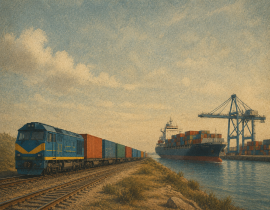
The Middle Corridor, also known as the Trans-Caspian International Transport Route (TITR), is a multimodal network comprising railways, roads and ports, designed to redraw the map of Eurasian (and global) trade, reducing dependence on the old routes—which lately have proven to be very vulnerable to politico-military conflicts—and serving as a bridge linking East Asia with Europe via Central Asia, the Caspian Sea and the Caucasus.
Tokyo is not the only one interested in this Corridor—as we have mentioned above, Seoul, Taipei and Beijing have also engaged vigorously, both diplomatically and economically, to secure access to the Central Asia’s geo-economic potential and especially to this Route, which remains today the last and most secure artery of one of the most important branches of transcontinental trade (known also as South-Eurasian trade route).
Meanwhile, global interest in Central Asia and its strategic geo-logistic position, was also evident in the draft-resolution proposed by the government of Tajikistan, on enabling transport and logistics connectivity for sustainable development in the Asia-Pacific region, which was adopted at the 82nd session of the United Nations Economic and Social Commission for Asia and the Pacific (ESCAP) in Bangkok, in April 2026.
This initiative aims to attract foreign investment (such as Japanese, Chinese, Korean, etc.) for developing and modernizing the ‘hard’ infrastructure, such as railways, roads and dry ports in Central Asian countries—in order to create an adaptable logistical network which would better connect the local markets of Central Asia with each other and more broadly, with the larger markets in Europe and the Asia-Pacific.
Conclusions
In the context of the current geo-political chaos, the countries of Central Asia have decided to act as a single bloc, rather than engage individually in bilateral relations with the major powers—a decision that has enhanced their negotiating power on the international stage while simultaneously preserving regional stability.
At the same time, the governments of these countries have agreed to adopt multi-vectorial foreign policy (similar in many aspects with Mongolia’s ‘Third Neighbor’ doctrine), that would prevent any major power from achieving total politico-economic dominance in the region.
To serve as a safety valve for this, as in the case of Ulaanbaatar, it has been decided that, for the most part, those countries which geographically do not pose any direct threat to the security of the major regional actors—Russia and the People's Republic of China—such as Japan, will be the ones to serve.
This also indirectly tells us that Tokyo is seen as a stabilizing factor and a partner, cooperation with which, besides being able to offer many profits, it has also reinforced the message that Central Asia does not depend solely on the two historic centers of power in the region (Moscow and Beijing), and that its countries are open to anyone seeking to cooperate with them.
But we must emphasize here that this partnership between Central Asian countries and Tokyo is primarily strategic and does not in any way aim to replace Russia or the People's Republic of China with Japan (an action which could destabilize the region's fragile balances).
However we can regard it as an undeniable symbol of the beginning of a new era in the countries of Central Asia, which now present themselves as more securely united in order to face the new geopolitical and geo-economic challenging realities
- TAGS :
- Russia
- Economy
- diplomacy
- Central Asia
- European Union
- Middle Corridor
- Silk way
- geopolitics
- Japan
- trade
- TOPICS :
- Economy
- Foreign policy
- Geopolitics
- Trade
- REGIONS :
- Central Asia
- East Asia and Pacific
About The Author

Eljanos Kasaj
Eljanos Kasaj
Expert
Eljanos Kasaj is a student from Albania, specialized at the Institute of Politology and World Politics, on the specialization of Global Security, in University of Wroclaw (Poland) and currently continuing studies at International Relations Department at Adam Mickiewicz University in Poznan (also in Poland).


jpg-1781074374.jpg)

jpg-1599133320.jpg)