
Politicon.co
Azerbaijan as a middle power: the policy of bridge-building and strategic balance in the Caspian Sea
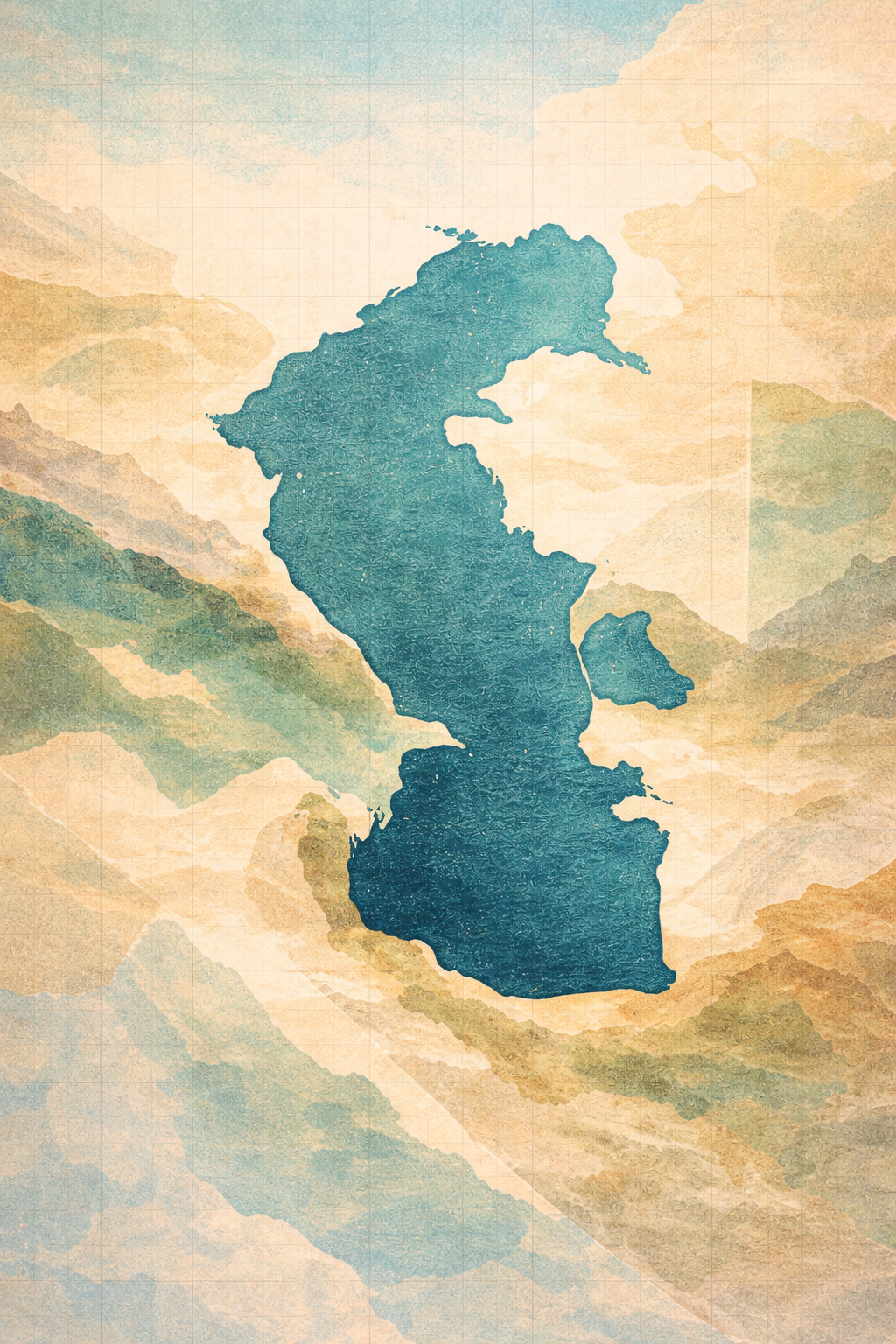
In an increasingly unstable international order, states’ survival and influence depend less on rigid alignments than on their ability to manage interdependence and forge connections. As the international system shifts toward a fragmented multipolar landscape, states with intermediate capabilities increasingly rely on flexibility, adaptability, and diplomatic dexterity. Rather than confronting great powers or accepting peripheral roles, these states expand their room for manoeuvre by acting as intermediaries, facilitators, and connectors across geopolitical spaces.
Situated at the crossroads of Europe, Asia, and the Middle East, Azerbaijan occupies a unique strategic position in the Caspian region. Bordering Russia, Iran, Georgia, Armenia, and the Caspian Sea, it connects multiple geopolitical and economic zones. This location, combined with its energy resources and transit infrastructure, enables Azerbaijan to project influence beyond its immediate environment, making it a valuable case for analysing how non-great powers exert international influence through active positioning.
Historically a hub for trade and exchange, Azerbaijan has, since independence in 1991, gradually consolidated its role as a key regional actor. Despite early challenges such as the Nagorno-Karabakh conflict and economic instability, the exploitation of oil and gas resources supported economic growth, infrastructure development, and international partnerships. Today, Azerbaijan’s role as an energy exporter and transport hub reinforces its growing centrality in the Caspian region.
Nevertheless, academic analyses of Azerbaijan remain limited, often focusing on post-Soviet transition, energy politics, or regional conflicts. These approaches frequently portray its foreign policy as reactive or externally driven, overlooking the coherence, continuity, and versatility of Baku’s diplomacy. As a result, Azerbaijan’s simultaneous engagement with Western, Eurasian, and Global South frameworks is often described as opportunistic rather than strategic.
Since 2020, however, Azerbaijani foreign policy has demonstrated a clear aspiration to evolve from a small power into an emerging middle power. This shift has been facilitated by post-conflict territorial changes, economic diversification, and sustained investment in connectivity infrastructure. Beyond material factors, this transformation is reflected in active mediation efforts, diversified diplomatic networks, and selective institutional participation. Viewed behaviourally, the concept of a middle power helps explain Azerbaijan’s strategic role choices rather than merely its material capabilities.
From this perspective, Azerbaijan’s post-2020 foreign policy illustrates a middle power strategy aimed at maximising autonomy in a competitive multipolar environment. By maintaining functional relations with actors such as Russia, the European Union, and the Non-Aligned Movement, Azerbaijan demonstrates adaptable and prudent positioning under conditions of strategic uncertainty.
This study therefore examines Azerbaijan’s middle power strategy through its “bridge policy”: a deliberate effort to leverage geography and connectivity to expand influence and promote regional integration. This approach is evident in projects such as the Middle Corridor and the Baku–Tbilisi–Kars railway, as well as active engagement in regional and international organisations. Beyond geo-economics, this policy seeks to enhance regional stability, facilitate dialogue, and contribute to a flexible multipolar order. The article argues that Azerbaijan’s bridge policy is not merely a product of geography but a deliberate middle-power strategy designed to maximise autonomy and manage interdependence amid systemic competition.
To read the full report, go here.
- TAGS :
About The Author

Natalia Castro
Natalia Castro is an advanced undergraduate student in Oriental Studies at Universidad del Salvador. She holds a Diploma in Korean Studies from the same institution and currently serves as an advisor to the Directorate of Parliamentary Diplomacy and International Cooperation of the Argentine Chamber of Deputies.
png-1773130770.png)

jpg-1599133320.jpg)