Elmar Ismayilzada received his bachelor's and master's degrees in International Relations from Baku State University. Since 2022, he has been pursuing doctoral studies in International Relations at the Azerbaijan University of Tourism and Management. His research areas include peace and conflict studies, as well as the foreign policy of European states.
Politicon.co
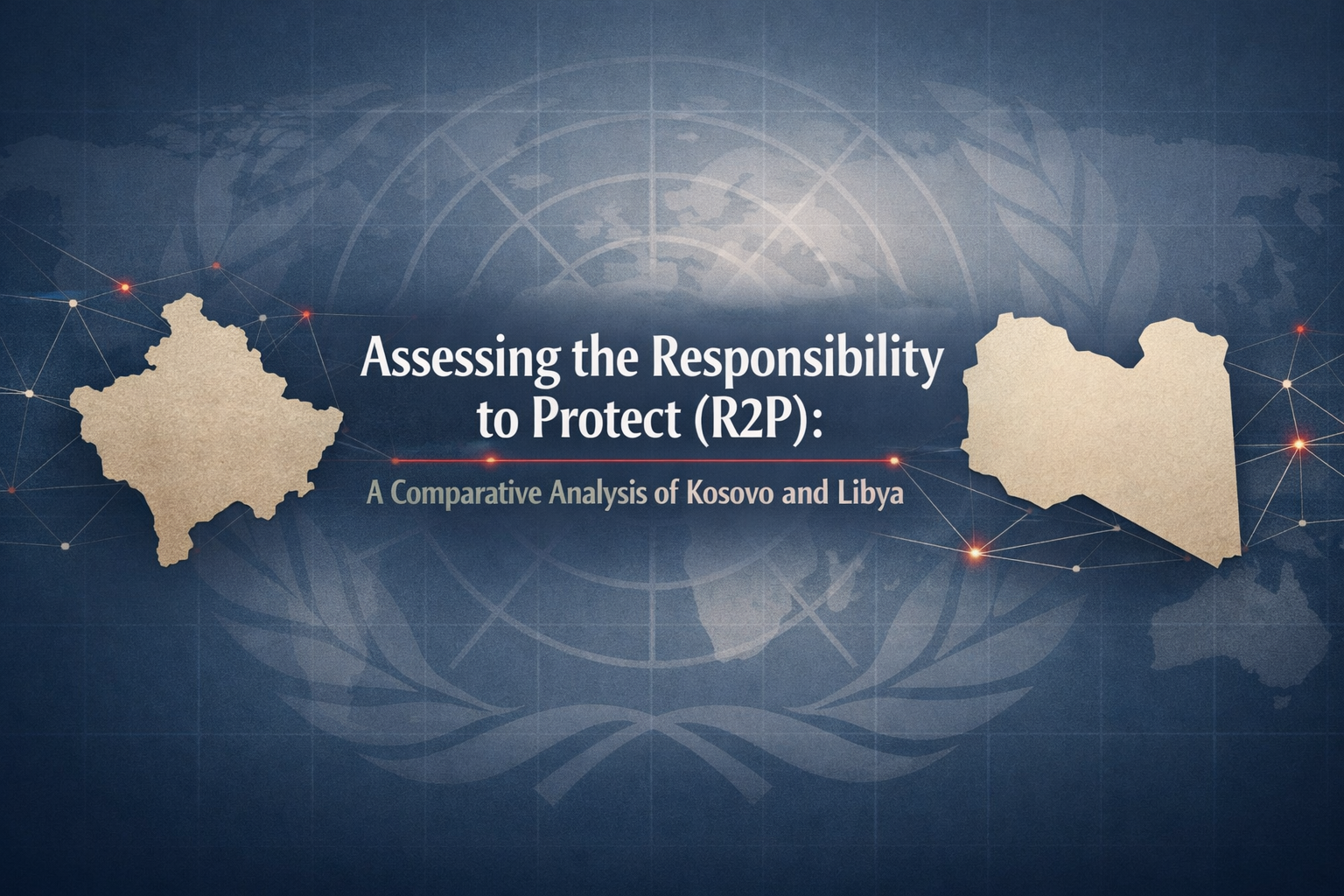
Assessing the R2P: cases of Kosovo and Libya in comparative analysis
Introduction
The concept of humanitarian intervention, framed by the Responsibility to Protect (R2P) doctrine, remains one of the most contentious issues in contemporary international relations. This article examines the core problem: the inherent tension between the humanitarian imperatives of the R2P framework and the geopolitical or strategic interests that often drive military action. This issue is vital for students of international law and policymakers alike, as it questions whether R2P serves as a genuine shield for civilians or a convenient tool for regime change. While academic literature frequently cites the 1999 Kosovo intervention as a case of "illegal but legitimate" action and the 2011 Libya intervention as a landmark of legal authorisation, a significant debate exists regarding whether these operations adhered to the ethical criteria.
This article argues that while both interventions were initially triggered by credible humanitarian threats fulfilling the "just cause" threshold, they both ultimately failed to maintain the "proportionality" required by the ICISS. This study fills a gap in the literature by providing a side-by-side comparative analysis of how military execution often exceeds humanitarian mandates. I contend that the failure to prioritise long-term "reasonable prospects" over short-term military success led to destabilisation, particularly in Libya. Ultimately, this analysis finds that the transition from civilian protection to strategic or regime-related goals erodes the normative legitimacy of R2P, suggesting that legal authorisation alone is insufficient to guarantee an ethical or successful humanitarian outcome.
The operationalisation of the Responsibility to Protect (R2P) framework necessitates a systematic evaluation of military actions against the normative benchmarks established by the International Commission on Intervention and State Sovereignty (ICISS). While the interventions in Kosovo and Libya are frequently cited as pivotal moments in the evolution of humanitarian norms, they represent distinct models of engagement that highlight the tension between ethical aspirations and realpolitik. To understand the degree to which these operations adhered to the doctrine’s requirements, it is essential to move beyond the immediate humanitarian rhetoric and analyse the structural integrity of each mission. The following analysis assesses these interventions across the ICISS criterions ranging from the initial legitimacy of the cause to the sustainability of the outcomes, thereby exposing the critical points where strategic interests and humanitarian mandates either align or diverge.
Criterion of “just cause” in interventions of Kosovo and Libya
During the Kosovo intervention, the widespread ethnic cleansing, mass violence, and systematic repression perpetrated by the Yugoslav authorities against the Kosovo Albanian population largely satisfied the ICISS criterion of “serious and irreparable harm.” By 1998–1999, security forces and affiliated paramilitaries were engaged in coordinated campaigns of forced displacement, extrajudicial killings, and the deliberate targeting of civilian communities. Entire villages were destroyed, and patterns of violence indicated not isolated abuses but a sustained strategy aimed at altering the demographic and political character of Kosovo. The forced displacement of hundreds of thousands of civilians into neighbouring states, combined with credible reports of mass killings and severe human rights violations, resulted in a rapidly escalating humanitarian emergency. This deterioration not only overwhelmed local coping capacities but also posed a direct threat to regional stability in the Western Balkans. Under these circumstances, the likelihood of further atrocities, including large-scale loss of civilian life, rendered international inaction increasingly untenable. From this perspective, the threshold of “just cause,” as defined by the existence of ongoing or imminently likely serious harm to human beings, can be considered to have been largely met in the Kosovo case.
A broadly comparable assessment was initially applied to Libya in early 2011. As the uprising against the Gaddafi regime intensified, official statements and military deployments by regime forces, particularly in relation to the opposition-held city of Benghazi, were widely interpreted as signalling an imminent threat of mass violence against civilians. Gaddafi’s public rhetoric, which framed opponents as traitors and promised to pursue them “house by house,” reinforced fears of large-scale reprisals. Given the regime’s prior record of repression and the rapid advance of loyalist forces toward densely populated urban centres, the prospect of mass atrocities was treated by the international community as both credible and urgent. United Nations Security Council Resolutions 1970 and 1973 explicitly acknowledged the risk posed to civilian populations and invoked the responsibility of the international community to act in order to prevent further harm. However, some critics argue that the threat to the civilian population was excessively exaggerated in order to justify the intervention. As a result, in the Libyan case, the “just cause” was primarily aimed at preventing the anticipated outbreak of mass violence (preventive in nature), although certain aspects remain politically contentious.
Criterion of “right intention” in interventions of Kosovo and Libya
By contrast, the ICISS criterion of “right intention” proves significantly more problematic in both interventions, revealing the inherent tension between humanitarian objectives and strategic considerations in the practice of international intervention. In the case of Kosovo, NATO’s military campaign was publicly justified through a humanitarian discourse emphasising the protection of civilians and the prevention of ethnic cleansing. However, humanitarian concern alone does not fully account for the decision to intervene. Broader strategic calculations such as the preservation of regional stability in the Balkans, the prevention of refugee flows into Western Europe, and the maintenance of NATO’s credibility as a security provider in the post–Cold War order played a substantial role in shaping both the timing and scope of the intervention. These factors suggest that humanitarian motives were closely intertwined with, and at times subordinate to, geopolitical interests.
Moreover, the absence of explicit authorisation from the United Nations Security Council further reinforced doubts regarding the purity of humanitarian intent in the Kosovo intervention. Acting without a clear legal mandate, NATO framed its operation as morally legitimate but legally exceptional, thereby implicitly prioritising political and strategic imperatives over adherence to established international legal procedures. This approach not only weakened the claim that civilian protection was the sole or overriding objective but also set a controversial precedent that blurred the distinction between humanitarian necessity and discretionary use of force.
In the Libyan case, the problem of right intention manifested itself in an even more pronounced manner. Although the intervention was initially justified under the Responsibility to Protect as a limited operation aimed at safeguarding civilians from imminent harm, the conduct of the mission evolved rapidly beyond these stated objectives. The expansion of military operations, including sustained airstrikes against regime assets and the provision of indirect support to armed opposition forces, effectively facilitated the overthrow of the Gaddafi regime. This shift from civilian protection to regime change indicated that the original humanitarian mandate had been reinterpreted or strategically exploited to pursue broader political goals. As a result, the intervention exceeded the normative boundaries of the Responsibility to Protect framework, constituting a clear violation of the “right intention” criterion and undermining confidence in the doctrine’s principled application.
Criterion of “last resort” in interventions of Kosovo and Libya
About the ICISS principle of “last resort,” the Kosovo intervention appears relatively more defensible when compared to the Libyan case, although it remains subject to important qualifications. Before the initiation of military action in 1999, a range of non-military instruments had been pursued in an effort to halt the escalating violence in Kosovo. These included intensive diplomatic initiatives such as the Rambouillet negotiations, sustained engagement by the Contact Group, the application of economic and political sanctions, and repeated warnings issued through international forums. Despite these efforts, Yugoslav authorities continued their campaign of repression, and diplomatic processes failed to produce meaningful concessions or a credible mechanism for civilian protection. The persistence and intensification of violence, combined with the apparent unwillingness of the Serbian leadership to comply with international demands, strengthened the argument that peaceful means had been exhausted and that military intervention had become, if not inevitable, at least the only remaining option capable of preventing further humanitarian catastrophe.
In contrast, the application of the “last resort” criterion in Libya was considerably more contentious. Although diplomatic measures were undertaken, including condemnation by the international community and the imposition of sanctions, the shift to military intervention occurred at a relatively early stage of the conflict. Notably, regional and diplomatic initiatives were not fully explored or given sufficient time to produce results before coercive measures were adopted. The rapid authorisation and implementation of military force thus created the perception that armed intervention was treated as a preferred rather than truly residual option. As a consequence, while some non-military measures were attempted, the failure to exhaust credible diplomatic alternatives suggests that the “last resort” criterion was only partially fulfilled in the Libyan case, raising further questions about the consistency and restraint of R2P’s application in practice.
Criterion of “proportionality” in interventions of Kosovo and Libya
The principle of proportionality proved to be one of the most controversial and contested aspects of both the Kosovo and Libya interventions, raising fundamental questions about the relationship between humanitarian objectives and the scale and conduct of military force. In the case of Kosovo, NATO’s operation was characterised by a sustained and intensive air campaign lasting seventy-eight days, during which a wide range of military and dual-use targets were struck. While the intervention aimed to halt ethnic cleansing and protect civilian populations, the reliance on high-altitude bombing significantly limited NATO’s exposure to risk but simultaneously increased the likelihood of collateral damage. The destruction of civilian infrastructure, along with documented civilian casualties, fueled criticism that the means employed exceeded what was strictly necessary to achieve the stated humanitarian goals. Rather than minimising harm to civilians, the scale and duration of the air campaign blurred the distinction between humanitarian protection and coercive warfare, thereby undermining compliance with the proportionality requirement.
In Libya, concerns regarding proportionality were even more pronounced. Although the use of force was initially authorised under a civilian protection mandate, the subsequent conduct of the intervention expanded far beyond narrowly defined protective measures. The extensive use of air power, combined with the targeting of regime military assets across the country and the provision of indirect military support to armed opposition forces, contributed to the rapid militarisation of the conflict. Rather than stabilising the situation, these actions facilitated the fragmentation of authority and the collapse of central state control, ultimately transforming the conflict into a prolonged and multifaceted civil war. The scale, intensity, and strategic direction of the military campaign thus clearly exceeded what was necessary to secure immediate civilian protection, indicating a significant violation of the proportionality principle and further eroding the normative credibility of the Responsibility to Protect.
Criterion of “reasonable prospects” in interventions of Kosovo and Libya
Important differences also emerge between Kosovo and Libya with respect to the ICISS criterion of “reasonable prospects,” which requires that military intervention have a credible likelihood of success and that its foreseeable consequences not outweigh the harms it seeks to prevent. In the case of Kosovo, the intervention produced a number of short-term outcomes that may be interpreted as limited humanitarian achievements. These included the cessation of large-scale violence against the civilian population, the return of a significant portion of displaced refugees, and the establishment of an international administrative and security presence under UN auspices. Taken together, these developments suggested that the intervention succeeded, at least temporarily, in mitigating the most immediate humanitarian threats and stabilising the situation on the ground.
Nevertheless, a longer-term assessment reveals that these gains were both partial and fragile. Persistent ethnic tensions between communities, unresolved questions of sovereignty and political legitimacy, as well as enduring economic underdevelopment and institutional weakness, continued to undermine sustainable peace and reconciliation. As a result, the Kosovo case illustrates that while the “reasonable prospects” criterion may have been satisfied in the short term, its fulfillment in the long run remained uncertain and contingent upon extensive external involvement and governance support.
In Libya, by contrast, the intervention failed to meet the “reasonable prospects” criterion in both the short and long term. Although the operation initially aimed to protect civilians from imminent harm, the overthrow of the Gaddafi regime was followed by the rapid disintegration of state institutions, the proliferation of armed militias, and the erosion of central authority. Rather than facilitating a transition toward stability and political order, the intervention contributed to a prolonged period of fragmentation, internal conflict, and regional insecurity. The resulting humanitarian and security conditions proved more severe and enduring than those that were likely to have occurred in the absence of military intervention. Consequently, the Libyan case underscores the risks inherent in interventions where post-conflict governance capacities are weak and where the anticipated humanitarian benefits lack a realistic and sustainable pathway, thereby fundamentally undermining compliance with the ICISS requirement of reasonable prospects.
Criterion of “right authority” in interventions of Kosovo and Libya
Finally, the criterion of “right authority” constitutes one of the clearest and most consequential points of divergence between the Kosovo and Libya interventions, as it directly concerns the legality and institutional legitimacy of the use of force in international relations. In the case of Kosovo, the intervention was undertaken without an explicit authorisation from the United Nations Security Council, primarily due to the anticipated vetoes of permanent members. This absence of formal approval significantly undermined the legal legitimacy of the operation under international law, placing it in a contested category often described as “illegal but legitimate.” While some actors sought to justify the intervention on moral or humanitarian grounds, the lack of Security Council authorisation weakened the normative coherence of the action and set a controversial precedent regarding the circumvention of established collective security mechanisms.
In contrast, the intervention in Libya was explicitly authorised by the United Nations Security Council through Resolutions 1970 and 1973, which invoked the responsibility to protect civilians and permitted the use of “all necessary measures” to that end. From a strictly legal perspective, this provided the Libyan intervention with a stronger foundation in international law and appeared to represent a significant advancement in the institutionalisation of the Responsibility to Protect doctrine. However, the existence of legal authorisation did not translate into ethical, political, or strategic success. As the intervention evolved, the expansive interpretation of the mandate, particularly the shift from civilian protection to de facto regime change, raised serious concerns regarding mandate overreach and the abuse of Security Council authority.
The comparative analysis of Kosovo and Libya reveals a fundamental tension within the Responsibility to Protect (R2P) framework: the gap between humanitarian justification and operational reality. In both instances, while the "just cause" was initially validated by the threat of mass violence, the subsequent military actions suffered from a loss of "right intention" as they evolved toward broader geopolitical goals and regime change. This pattern suggests that humanitarian intervention, even when triggered by genuine suffering, is rarely insulated from the strategic interests of the intervening powers. Consequently, the integrity of the R2P doctrine is compromised when the protection of civilians becomes a secondary byproduct of political restructuring.
Furthermore, these cases demonstrate that legal authorisation through the United Nations does not inherently guarantee a successful or ethical outcome. While Libya possessed a clear legal mandate that Kosovo lacked, both interventions failed the test of "proportionality" by causing extensive infrastructure damage. The lesson derived from this comparison is that a successful intervention requires more than just military superiority; it demands a commitment to post-conflict stability that neither operation fully achieved. Ultimately, without a sustainable pathway for governance, military force serves only to exchange one form of humanitarian crisis for another.
Conclusion
In summary, this comparative analysis of the interventions in Kosovo (1999) and Libya (2011) demonstrates the complexities of applying the Responsibility to Protect (R2P) doctrine in practice. Both cases illustrate that while "just cause" may be established through the threat of mass atrocities, the subsequent military operations struggled to satisfy the ICISS criteria. In Kosovo, strategic calculations and the lack of UN authorisation clouded the humanitarian mandate. In Libya, despite having "right authority" through UN resolutions, the mission’s shift toward regime change and the resulting state collapse violated the principles of proportionality and long-term stability. The findings suggest that when humanitarian action is used to pursue broader political goals, it undermines the very framework designed to protect vulnerable populations. Future research should focus on developing more robust mechanisms for monitoring mission creep during authorised interventions to ensure that the "right intention" remains focused on civilian protection rather than political transformation.
- TAGS :
About The Author

Elmar Ismayilzada

png-1773130770.png)
jpg-1599133320.jpg)