
Politicon.co
Legal aspects of the Imia/Kardak dispute
Introduction
There are few things in international relations as abiding and ancient as the disputes between Greece and Turkey. There are likewise few things as wide-ranging in their effects. Greece-Turkey disputes affect a wide range of issues, from quotidian questions of customs regulations, which would normally be handled by the European Commission with little ado, to military operations in the Middle East and the diplomacy surrounding the war in Ukraine—how much does NATO want Turkey as a mediator?
To some degree, the side one takes between Greeks and Turks, of course, depends on one’s own national interest and one’s current relations with each side. Yet, a war of narratives still exists, and it is important, as it takes an active role in shaping the attitudes of certain cadres and political parties. (‘Party’ is meant in the nineteenth-century sense of a section of people or a party of opinion as opposed to a formal political organisation; the parties in question transcend formal political party affiliations.) The perceptions of these parties, in turn, affect policy. The war of narratives also does not just affect the perceived rightfulness or wrongfulness of Greece, Turkey, or Cyprus about a particular issue; it feeds into perceptions about the general role and motives of these states. So it is worthwhile to find out how valid these narratives are and if the perceptions of these parties are justified, and set the record straight.
It is especially worthwhile for Azerbaijanis. Although the disputes between Turkey and Greece and Greek and Turkish Cypriots do not involve Azerbaijan, they are of indirect but substantial interest to it. With what is going on in the Caucasus, Azerbaijan has a deep interest in international law and precedent. It also has an interest in the way that its crucial partner, Turkey, is perceived and whether Turkey, so to speak, holds water, in terms of international law in international fora.
There are Turkish accusations toward Greece and Cyprus, about the militarisation of certain islands and Greek and Cypriot declarations of territorial waters and airspace. Yet current discourse happens to be focused more on whether Turkey is or is not at fault, and is marked by Greek and Greek Cypriot claims against Turkey. These fall under three broad claims.
Turkey is encroaching on the territorial rights of Cyprus and Greece.
In relation to these, Turkey is encroaching on the maritime rights of Cyprus and Greece.
The former two are part of a broader irredentist Turkish policy, enshrined to some extent in the Blue Homeland doctrine.
Turkey often takes the actions Gthat reece and Greek Cypriots accuse it of. Yet for Greek and Greek Cypriot accusations to amount to valid grievances, it is logically necessary that Turkey first be in the wrong. Since maritime rights depend on territorial rights, and irredentism or aggression can only happen when what one is trying to take does not belong to one, one must first address the question of territorial rights. The elephant in the room in that regard is, of course, Cyprus. Yet that ends up being a discussion about the legitimacy of unilateral secession. It has also been written about elsewhere. So this article discusses the question of Imia, or in Turkish, Kardak, and as the Imia question is considered a class action by Turkey, other islands in the Aegean. On the whole, it is found that the question of rectitude boils down to the intricacies of interpretation in international law. The ultimate answer depends on one’s legal doctrine. As such, the dispute should not be viewed as an act of straightforward criminality on the part of either party, but rather a run-of-the-mill, nuanced diplomatic dispute. This is a view that would also promote the dispute’s peaceful resolution.
The Dispute
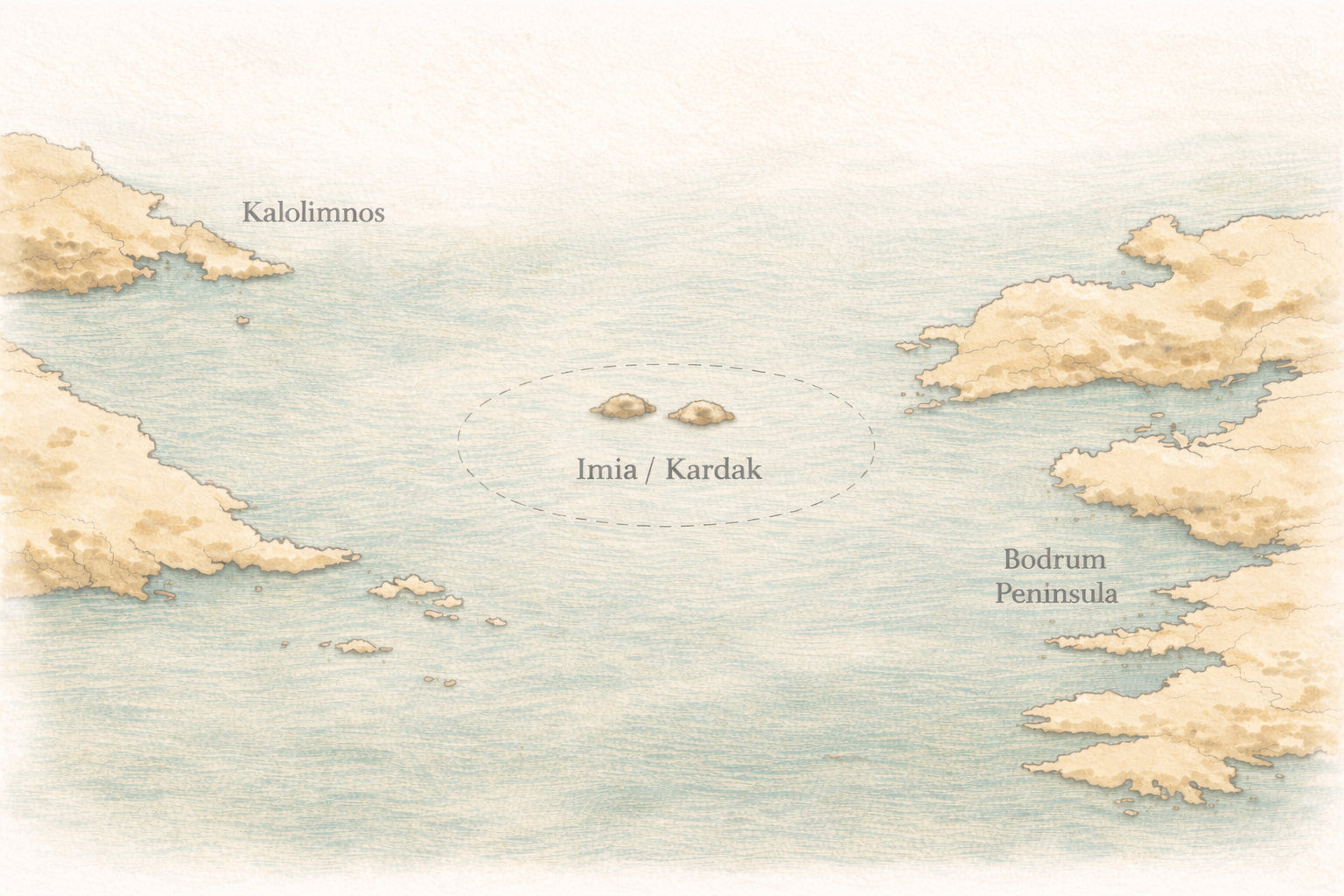
The essential dispute about Imia, and all other islands like it, is whether Turkey, or rather its predecessor, the Ottoman Empire, ever gave up its sovereignty over the islet or rock in question. The Treaty of Lausanne, after the First World War, “confirmed the sovereignty of Greece over the islands of the Eastern Mediterranean,” recognised in a note verbale of the Six Powers convened at a conference in London on February 13th, 1914. The note confirmed the sovereignty of Greece over the islands it had occupied as a result of the Balkan Wars. These islands, though, were in the northern Aegean. Indeed, there were no Greek forces around the islet of Irmia, the islands in the South, the Dodecanese had been occupied by the Italians. The treaty ceded these to the Italians. It spelt out that fourteen islands and the islets “dependent” on them to the Italians: Astypalia, Rhodes, Chalki, Karpathos, Kasos, Tilos, Misyros, Kalymnos, Leros, Patmos, Leipsoi, Symi, Kos, and Castellorizo. The treaty also stipulated that islands within three miles of the Turkish coast remain Turkish.
Imia lies four or five, not three, miles off the Turkish coast; but it is closer to the Turkish coast than to any of these islets. Yet the landmass it is closest to is a Greek islet, Kalolimnos, which in turn is closest to Kalymnos.
Turkey claims on the basis that it is closest to the Turkish coast that it was not an islet dependent upon Kalimnos and thus never ceded. Greece contends that there is confirmation that Turkey ceded the island: Convention between Italy and Turkey (1932). An annex to the convention leaves Imia on the Italian side of the border.
But does this annex count? Turkey argues that international agreements are supposed to be deposited by the signatories to the UN, and before the existence of the UN, it was supposed to be with the League of Nations. Parties have no recourse to undeposited agreements before the UN. The annexe, in this case, was not deposited with the UN. Greece retorts that it is customary that undeposited agreements still have validity; moreover, the annex counts as deposited since the convention proper, which it annexes to, was submitted.
Here, the dispute becomes about the nuts and bolts of international law. What is the nature of undeposited agreements? What is the status of agreements where the main agreement was deposited, but the particularly relevant area was not?
Customarily, undeposited agreements, if they signal a commitment by states, can be considered binding between them; however much they cannot be used at the United Nations—interestingly, a crime of aggression can only occur through a violation of the United Nations charter. The necessary conclusion then—although one is out on an edge here—is that there exists a difference between aggression or bad faith in general and aggression and bad faith accountable before the United Nations; between general aggression or bad faith and between aggression and bad faith proper. This would make undeposited treaties like treaties before the establishment of the League of Nations, not without validity but without the guarantee of the United Nations behind them, and that is important because it is the United Nations that legally guarantees peace.
One must, however, observe that the rules about the registration of treaties during the interwar period were theoretically stricter. Article 102 of the UN stipulates:
1. Every treaty and every international agreement entered into by any Member of the United Nations after the present Charter comes into force shall, as soon as possible, be registered with the Secretariat and published by it.
2. No party to any such treaty or international agreement which has not been registered in accordance with the provisions of paragraph 1 of this Article may invoke that treaty or agreement before any organ of the United Nations.
But its League of Nations equivalent, Article 18, states:
Every treaty or international engagement entered into hereafter by any Member of the League shall be forthwith registered with the Secretariat and shall, as soon as possible, be published by it. No such treaty or international engagement shall be binding until so registered.
The difference in language between the two documents is not accidental. The problem with the League of Nations equivalent was that it created a two-tiered system of international law: solemn covenants on the one hand, and on the other, a whole host of arrangements which could in effect shape the world order but legally would be considered little more than gentlemen’s agreements. Reducing important documents to the level of gentlemen’s agreements was thought to have rendered the world order unstable. In short, the change of language with the United Nations was designed exactly to avoid situations like Imia, where a cessation was made, but its validity later on could be called into question. Yet to apply this rule to the treaty about Imia would be retroactive.
However, all this is if the cession of Imia went unregistered. Its parent treaty was registered. So should not the annex also count as registered? The answer is that it depends, and as before, consent is the key. The criterion is whether a document was truly part and parcel of the originally signed agreement; for instance, the results of a demarcation mission established by a treaty, versus a genuine, novel addition to that treaty. In this case, an effort by Turkey and Italy to demarcate their frontiers is apparent, but the document does not explicitly anticipate the demarcation that took place around Imia.
Who is right, Turkey or Greece? In truth, it depends on the priorities of the judge. An approach which stresses the inviolability of borders and the honouring of agreements at all costs would favour Greece; one that stresses the procedure of treaty-making and the all-important factor of whether consent was truly established would favour Turkey. So far, the courts have tended to go with the former—a critic, though, would point out that that could be judges giving weight to their own priorities rather than the law.
Conclusion and steps to resolution
Just as international law shies away from giving a very clear answer about how to interpret treaties in the circumstances described above, international courts are equally recalcitrant in naming one or another party criminal in a genuine, good-faith dispute like Imia. What must be avoided is a repeat of the 1996 crisis, when US President Bill Clinton was woken up in the middle of the night to keep two NATO countries from going to war. Indeed, peace is part of the national interest. However much Imia or Kardak may be part of the fatherland, it is relatively barren and small. But the sea that surrounds it is among the best waters to be found anywhere—the very scale of tourism in the region attests to this—and that sea constitutes part of the Greek and Turkish fatherlands—indeed, that is the very point made by the much vaunted and much denounced Blue Homeland doctrine. Rather than focusing on which piece of territory is whose, it may be better if Greece and Turkey turned their attentions to the joint and good management of that sea. Sabre-rattling does not suit either party, nor does antagonising one party by caricaturing it as a villain. Many Greeks and Turks derive their sustenance from that sea, not to mention the non-human environment worth protecting. Governments should be mindful of international law, of the environment, and of their own interests and those of their populations.
- TAGS :
- TOPICS :
- Conflict and peace
About The Author
 (4)JPG-1768557899.JPG)
Onur Anamur
Onur Anamur is a Turkish-Canadian writer on global affairs, defense, and energy. He is a graduate of Middle East Technical University, in Ankara, Turkey. He was recognized as a top young European journalist in 2021 by the European Commission as part of its Youth for Regions programme. He is currently a researcher at the Europinion Institue for Research; a staff writer for Transatlantic Policy Quarterly, formerly Turkish Policy Quarterly, Turkey's long-standing journal of international affairs; and an editor of Our Views for the Atlantic Forum, a networking organization co-sponsored by NATO. He is also an analyst of North American energy markets with a Canadian energy consultancy, Energy Advantage.

png-1773130770.png)

jpg-1599133320.jpg)